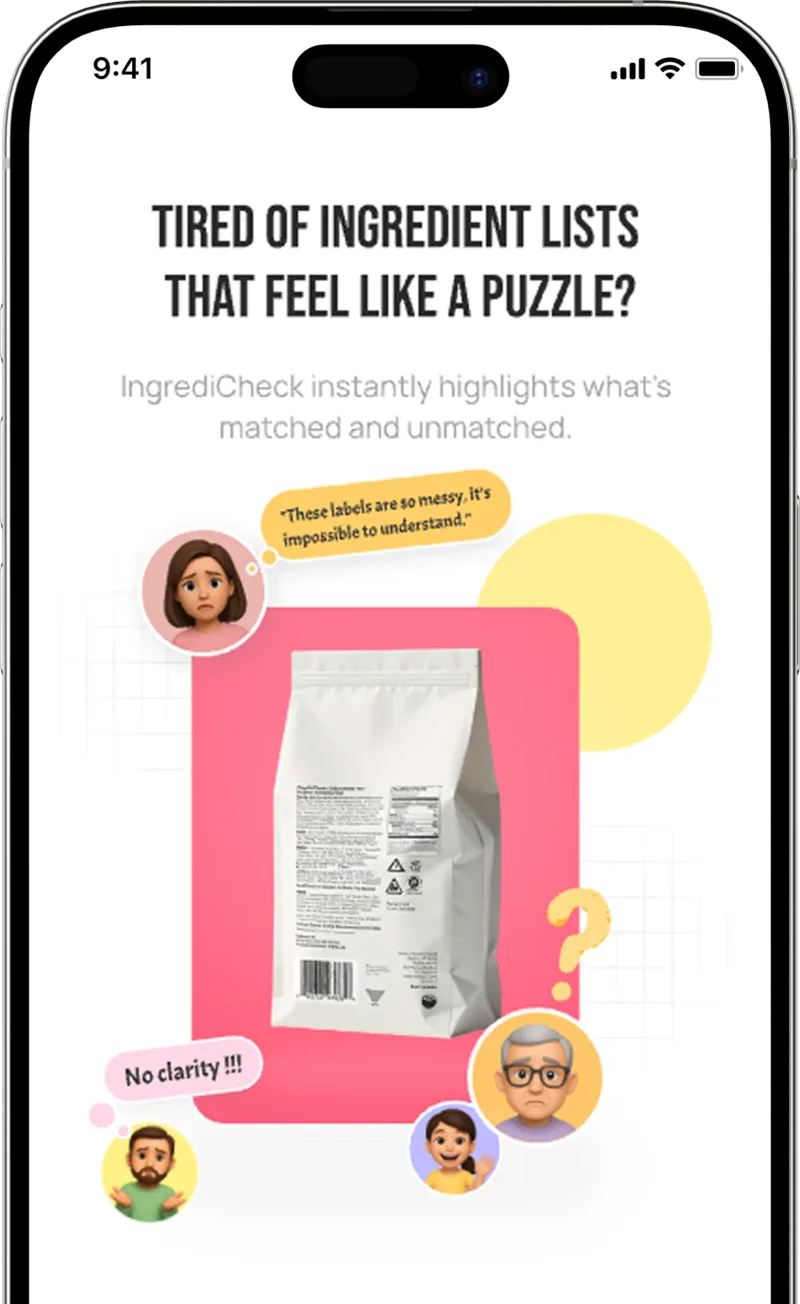
Mammalian meat and fat
Beef, pork, lamb, venison, organ meat, lard, tallow, suet, meat broth, and animal fat are clearer label clues than additives whose biological source is omitted.
Alpha-gal shopping is a source-checking problem, not just a red-meat problem. IngrediCheck helps you scan packaged foods against saved alpha-gal rules, flag mammalian clues such as gelatin, lard, broth, dairy ingredients, and source-dependent additives, and decide which labels still need slower review.
Quick answer
IngrediCheck is currently a free iOS and Android option for shoppers who want to scan a barcode or ingredient label against saved alpha-gal rules. It may fit that job, but no app is universally best: IngrediCheck cannot identify undisclosed mammalian sources, predict reactions, or replace clinician and manufacturer guidance.
What It Catches
Workflow
Read the label
Beef, pork, lamb, venison, organ meat, lard, tallow, suet, meat broth, and animal fat are clearer label clues than additives whose biological source is omitted.
Gelatin, collagen, dairy ingredients, glycerin, magnesium stearate, enzymes, flavors, and some emulsifiers may matter differently under each person's clinician-guided alpha-gal plan.
Processing aids, capsule materials, flavor carriers, shared equipment, and supplier-specific sources may be absent from a retail ingredient panel and can require manufacturer or pharmacist confirmation.
Decision boundary
IngrediCheck can show which declared terms matched the alpha-gal rules you saved. It cannot identify an ingredient's undisclosed species source, predict delayed reactions, assess medication excipients, or decide whether dairy is tolerated. Use clinician guidance and direct confirmation for ambiguous or high-risk products.
Detailed label guide
The best alpha-gal app is the one that fits the user's clinician-guided rules and makes its evidence understandable. Look for barcode and ingredient-label scanning, named matches, editable saved rules, separate outcomes for clear mammalian ingredients and source-dependent terms, and an honest unresolved state. A single universal safe score is a poor fit for alpha-gal syndrome because tolerance, dairy decisions, medication needs, and the strictness of each plan can differ.
IngrediCheck is currently a free alpha-gal app on iOS and Android. A shopper can scan a barcode or ingredient panel, compare it with saved rules, and see why a term matched. Optional one-time tips do not unlock features or change results. That makes the app useful for grocery screening, but it does not prove IngrediCheck is universally best and it should not be described as a diagnostic, reaction tracker, restaurant-certification service, or substitute for an allergist.
When comparing IngrediCheck with Fig or another alpha-gal scanner app, test the same current packages and inspect the explanations rather than relying only on a product-level color. Check whether the tool exposes gelatin, broth, fats, dairy clues, and ambiguous additives; whether it lets the user save personal exceptions; and whether it admits when the biological source is not declared. Database coverage, country, product freshness, and available label text can change the result in every app.
Start with the clearest label evidence: beef, pork, lamb, venison, rabbit, organ meat, lard, tallow, suet, meat broth, meat stock, gelatin, and collagen from mammals. Some people with alpha-gal syndrome also avoid dairy ingredients under clinician guidance, while others tolerate them. The scan should name the declared ingredient and the saved rule it matched instead of extending one person's dairy or gelatin decision to everyone.
Maltodextrin and corn starch deserve a different result. In U.S. foods, maltodextrin is commonly made from plant starches such as corn, potato, rice, or wheat, and corn starch is plant-derived; neither name alone establishes a mammalian source. A scanner should not label either term universally alpha-gal safe or unsafe. Supplier processing aids, flavor carriers, compound ingredients, and a person's care plan may still create a question that the retail panel cannot answer, so ambiguous cases belong in needs-review rather than an invented verdict.
Apply the same source discipline to glycerin, glycerol, mono- and diglycerides, magnesium stearate, stearic acid, enzymes, natural flavors, emulsifiers, and capsule materials. Some can come from plant, synthetic, microbial, or animal sources, and the package often does not identify which. Flag the exact term, check whether the manufacturer discloses its source, and ask a focused question when the answer matters. The absence of an obvious meat word is not proof that every source-dependent ingredient fits the user's rule.
Use the alpha-gal scanner most deliberately on gummies and marshmallows, soups and bouillon, gravies and sauces, seasoning packets, bakery products, dairy snacks, protein bars, supplements, and products made with animal fat. Read the complete current ingredient panel and sub-ingredients. A front claim such as plant-based, dairy-free, gelatin-free, or natural answers only the named question and does not disclose every broth, fat, flavor carrier, processing aid, or reformulation.
Barcode scanning is fast when the record matches the exact flavor, size, country, and formula. A label photo is stronger evidence when a product is new, imported, or recently changed. Compare the digital result with the physical package and recheck repeat purchases after any packaging or ingredient change. If the manufacturer does not disclose the biological source of an additive, preserve that uncertainty instead of letting an old database value become proof.
Keep packaged-food review separate from medicines and medical products. IngrediCheck is not an alpha-gal medication checker and cannot assess prescription ingredients, inactive ingredients, capsule shells, vaccines, medical devices, or hospital products. A pharmacist, prescriber, manufacturer, and the patient's alpha-gal care plan are the right sources for those decisions. A grocery scan result should never be carried over to a medication simply because an excipient has a familiar name.
Name the profile around the plan the person actually follows: for example, avoid mammalian meat and gelatin, review dairy separately, or confirm source-dependent additives. Scan the current package, resolve direct mammalian matches first, then review ambiguous sources and cross-contact language. Keep each rule visible so a family member can understand why the same food might be rejected for one person, held for confirmation for another, and outside a third person's alpha-gal restrictions.
Compare products under that same saved profile. A gummy without gelatin may still use an unresolved flavor carrier; a soup without meat pieces may contain beef stock or animal fat; a seasoning without a clear mammalian ingredient may use an additive whose source is omitted. Prefer products with declarations that are easier to verify, keep manufacturer answers attached only to the exact formula discussed, and rescan after reformulation. The app organizes evidence but cannot predict a delayed reaction or establish personal tolerance.
Restaurant menus, foods prepared by other people, supplements, and incomplete online listings require a stricter boundary because ingredients, preparation surfaces, and source details may be missing. Use available text to prepare focused questions, then rely on clinician guidance and direct confirmation when uncertainty matters. An alpha-gal app can make grocery screening faster and more repeatable; it cannot turn undisclosed sourcing into certainty or replace the safeguards in an individual's medical plan.
Related Scanner Paths
Check Foreign Food Labels Against Your Food Notes
Use IngrediCheck to photograph some foreign food labels, review available ingredient information, and check it against saved Food Notes while traveling.
Dairy-Free Ingredient Checker App
Use IngrediCheck's dairy-free ingredient checker to scan labels for milk, whey, casein, ghee, lactose, and may-contain milk statements.
Egg-Free Ingredient Checker App
Scan labels for egg, albumin, lysozyme, ovalbumin, mayonnaise, and household allergy rules with IngrediCheck's egg-free checker.
Lecithin
Lecithin is a broad label term for phospholipid-rich emulsifiers used in chocolate, baked goods, dressings, infant foods, and supplements. The source can be soy, sunflower, egg, or less commonly animal tissue.
Xanthan gum
Xanthan gum is a fermentation-derived thickener that shows up in gluten-free baking, sauces, dressings, and frozen desserts. It is often the ingredient that gives wheat-free products enough structure to hold together.
Calcium propionate
Calcium propionate is a mold-inhibiting preservative commonly used in bread, buns, tortillas, and other packaged baked goods. It matters because it sits at the center of a real shelf-life tradeoff between softer bread products and simpler ingredient decks.
Label Clues
emulsifier
Lecithin: what it does in food, current safety notes, diet compatibility, and shopper guidance from IngrediCheck.
thickener
Xanthan gum: what it does in food, current safety notes, diet compatibility, and shopper guidance from IngrediCheck.
preservative
Calcium propionate: what it does in food, current safety notes, diet compatibility, and shopper guidance from IngrediCheck.
Related Guides
Apr 22, 2026 | 8 min read
An alpha-gal food scanner helps shoppers spot mammalian ingredients like gelatin, lard, broth, dairy clues, and source-dependent additives faster while checking packaged foods against saved rules.
Apr 21, 2026 | 8 min read
A practical guide to checking packaged foods against your own allergies, diets, and ingredient preferences, instead of relying on a generic food score.
Apr 13, 2026 | 8 min read
A food allergy scanner app or food allergen checker helps families catch allergens, ingredient derivatives, and label risks faster than manual label reading. Here's what to look for and how IngrediCheck works.
FAQ
No. Alpha-gal syndrome is a medical condition that should be managed with a clinician. IngrediCheck can support label screening, but it cannot diagnose alpha-gal syndrome or replace medical guidance.
Gelatin, lard, tallow, meat broth, collagen-related ingredients, dairy clues, and source-dependent additives can deserve review depending on the alpha-gal rule your household follows.
Yes. IngrediCheck is currently free to download and use on iOS and Android. Optional one-time tips do not unlock features or change results. The official listings use Apple app ID 6477521615 and Android package llc.fungee.IngrediCheck; the official domain is ingredicheck.app.
Scan labels, see what fits your food notes, and read the why in plain English.