Quick answer: No. Reheating rice can kill live Bacillus cereus bacteria, but it does not reliably destroy cereulide, the heat-stable toxin those bacteria can make in rice, pasta, noodles, and other starchy leftovers. The safety step is prevention: cool cooked food quickly, refrigerate it promptly, and do not rely on a microwave to fix leftovers that sat out too long.
Ingredient Deep Dives
Bacillus cereus Toxin in Reheated Rice: Is It Safe?
Bacillus cereus toxin in reheated rice can survive cooking once cereulide forms. Learn the symptoms, risky foods, and safe storage rules.
Mar 25, 2026|9 min read
Start from the cluster
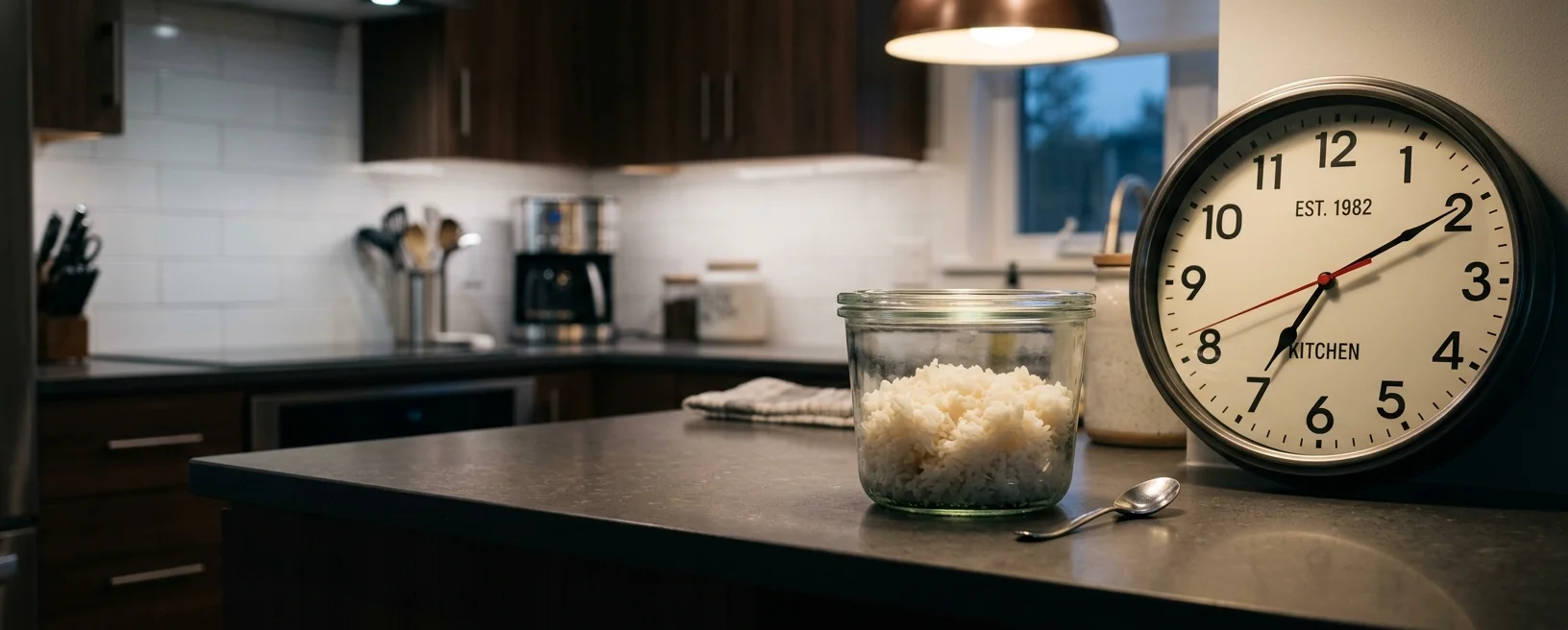
Reheated Rice Safety: Time and Temperature Table
| Situation | What happens | Safest action |
|---|---|---|
| Rice has just finished cooking | Bacillus cereus spores may survive cooking, but toxin has not necessarily formed | Eat promptly, keep it hot above 60°C (140°F), or begin cooling it immediately. |
| Rice is cooling for storage | A deep, covered pot can stay warm long enough for surviving spores to grow | Divide rice into shallow containers and refrigerate promptly. Aim for within 1 hour and never leave it at room temperature beyond 2 hours. |
| Rice has sat at room temperature for more than 2 hours | Bacteria may have multiplied and cereulide may already be present | Discard it. Smell, appearance, frying, boiling, and microwaving cannot confirm or restore safety. |
| The surrounding temperature is above 32°C (90°F) | Bacteria can multiply faster in hot kitchens, cars, picnics, or outdoor meals | Refrigerate within 1 hour or discard it. |
| Rice was refrigerated promptly | Cold storage slows bacterial growth but does not sterilize the food | Keep it cold, use it within 2 days under this conservative guidance, and reheat only once. |
| Refrigerated rice is being reheated | Reheating can kill live bacteria but cannot reliably destroy preformed cereulide | Heat throughout to 74°C (165°F). Only reheat rice that was cooled and stored safely. |
The same prevention rules apply to cooked pasta, noodles, grains, and other starchy leftovers. The clock starts after cooking, not when the food is finally placed in the refrigerator.
Does Reheating Destroy Bacillus Cereus Toxin?
Reheating can kill live Bacillus cereus bacteria, but it does not reliably remove cereulide once that toxin has formed. Cereulide is heat-stable, so cooked rice, pasta, noodles, or grains that sat too long at room temperature can stay unsafe even after boiling, frying, or microwaving.
For the compact reference path, start with the cereulide ingredient profile and the broader Food Contaminants hub. This article explains the full evidence behind the Bacillus cereus heat-stable toxin and why reheating does not make unsafe rice safe again.
You cook a pot of rice, eat half, and leave the rest on the counter. You reheat it the next day. Seems harmless enough. People do this every day. But if those leftovers sat out long enough, reheating could actually make them more dangerous, not less.
The culprit is cereulide: a heat-stable toxin produced by the bacterium Bacillus cereus that no amount of cooking, microwaving, or boiling can destroy once it has formed. It's invisible, odourless, tasteless, and in rare but documented cases, deadly.
This is what food scientists call the "fried rice syndrome." It's more serious than most people realise, and understanding how cereulide forms is the only real protection against it.
What Is Cereulide? The Bacillus Cereus Toxin in Rice
Cereulide is a cyclic depsipeptide, a small ring-shaped molecule produced by certain strains of Bacillus cereus as a byproduct of bacterial growth. Unlike most bacterial toxins, cereulide is not a protein. That matters enormously, because it means:
- It survives temperatures up to 121°C (250°F), well above boiling point
- It is resistant to acidic and alkaline environments
- It cannot be broken down by the digestive enzymes in your gut
- No amount of reheating destroys it once it has been produced in food
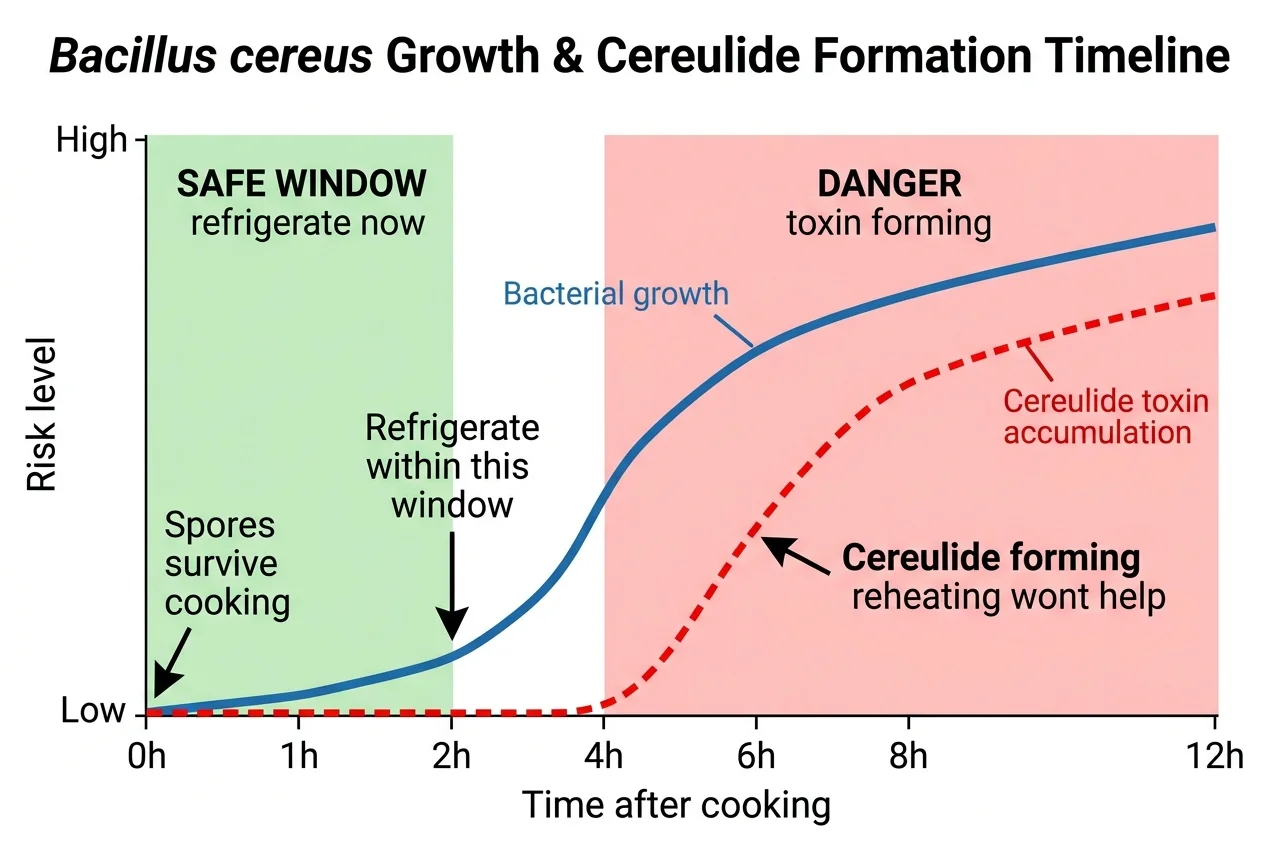
Bacillus cereus is a spore-forming bacterium that lives in soil and is commonly found on raw rice, grains, vegetables, and many other foods. The spores are extraordinarily robust: they survive normal cooking temperatures without difficulty. When cooked rice sits at room temperature, those spores germinate, bacteria multiply, and under the right conditions, primarily temperatures between 25°C and 30°C (77–86°F), toxin production begins.
The window is faster than most people expect. Significant cereulide accumulation can begin in as little as 6 hours at room temperature.
Why Reheating Rice Doesn't Destroy Cereulide
This is the most important thing to understand about cereulide: the bacteria and the toxin are separate problems, and cooking only addresses one of them.
Reheating rice to a safe internal temperature (165°F / 74°C, as the FDA recommends) will kill any live Bacillus cereus bacteria present. But if cereulide has already formed in the rice during the time it sat out, that toxin remains fully active in your food. You've killed the bacteria and left the poison.
Cereulide has been shown to survive autoclaving at 126°C for 90 minutes in laboratory conditions, far more heat than any home kitchen generates.
This is what separates cereulide from most foodborne hazards, where thorough cooking provides real protection. With cereulide, prevention must happen before the toxin forms, not after.
The Symptoms: Emetic vs. Diarrheal Illness
Bacillus cereus actually causes two distinct types of food poisoning, produced by two different toxins:
Emetic illness (cereulide):
- Caused by cereulide, which is preformed in food before it is eaten
- Symptoms: sudden, violent nausea and vomiting
- Onset: typically 30 minutes to 6 hours after eating
- Duration: usually resolves within 6–24 hours in healthy adults
- Most commonly associated with rice, pasta, and starchy foods
Diarrheal illness (enterotoxins):
- Caused by enterotoxins produced inside the body after ingesting live bacteria
- Symptoms: abdominal cramps and diarrhoea
- Onset: 6–15 hours after eating
- Most commonly associated with meat, poultry, soups, and sauces
Most cases of cereulide poisoning resolve without medical treatment. But the emetic form carries a serious risk in vulnerable populations, particularly infants, young children, and those with underlying liver conditions, where the toxin can cause devastating complications.
When It Turns Fatal
Cereulide is a mitochondrial toxin. It disrupts the electron transport chain, the process cells use to generate energy, which can trigger cell death in multiple organs simultaneously. In severe cases, this manifests as acute liver failure, rhabdomyolysis (muscle breakdown), metabolic acidosis, and multi-organ failure.
Documented fatal cases are rare but real. Research published in PMC has described cases of fulminant liver failure caused by cereulide, including a 20-year-old Belgian student who died after eating five-day-old pasta he had left at room temperature. In another documented case, a one-year-old child died of acute encephalopathy after consuming reheated fried rice.
A global analysis spanning 50 years identified 6,135 cases of B. cereus infection across 266 studies, with a mortality rate of approximately 0.05% among food poisoning cases. That's a small figure that still represents real deaths from what is widely considered a "minor" foodborne illness.
Children under two years old and school-age children appear disproportionately at risk for severe outcomes, including fulminant liver failure.
The 2026 Regulatory Wake-Up Call
In early 2026, cereulide moved firmly onto regulators' radar when Bacillus cereus toxin was detected in infant formula products from multiple manufacturers, triggering a precautionary global recall.
In response, the European Food Safety Authority (EFSA) published a rapid risk assessment establishing, for the first time, an Acute Reference Dose (ARfD) for cereulide in infants: 0.014 µg per kilogram of body weight. EFSA applied a standard uncertainty factor of 100, plus an additional factor of 3 to account for the reduced metabolic capacity of very young infants, reflecting how differently neonates process toxins compared to adults.
The assessment also established safety thresholds for reconstituted infant formula:
- Cereulide above 0.054 µg/L in standard infant formula may exceed the ARfD
- Cereulide above 0.1 µg/L in follow-on formula raises safety concerns
This regulatory milestone matters beyond infant formula: it signals that food safety authorities are beginning to quantify cereulide risk systematically, which may eventually lead to broader monitoring requirements across rice, pasta, and grain products.
Foods Most at Risk
Rice is the highest-risk category. A PMC review of B. cereus food safety risk found that rice was associated with 43 documented foodborne incidents, more than any other single food type for cereulide-producing strains. But it is not the only risk:
- Pasta and noodles: implicated in multiple severe cases including deaths
- Cooked grains (quinoa, barley, millet)
- Potato dishes
- Cooked vegetables
- Dairy products: particularly relevant given the 2026 infant formula recall
The common thread is starchy or protein-rich foods that have been cooked and then held at room temperature, providing ideal conditions for spore germination and toxin production.
The Right Prevention Strategy
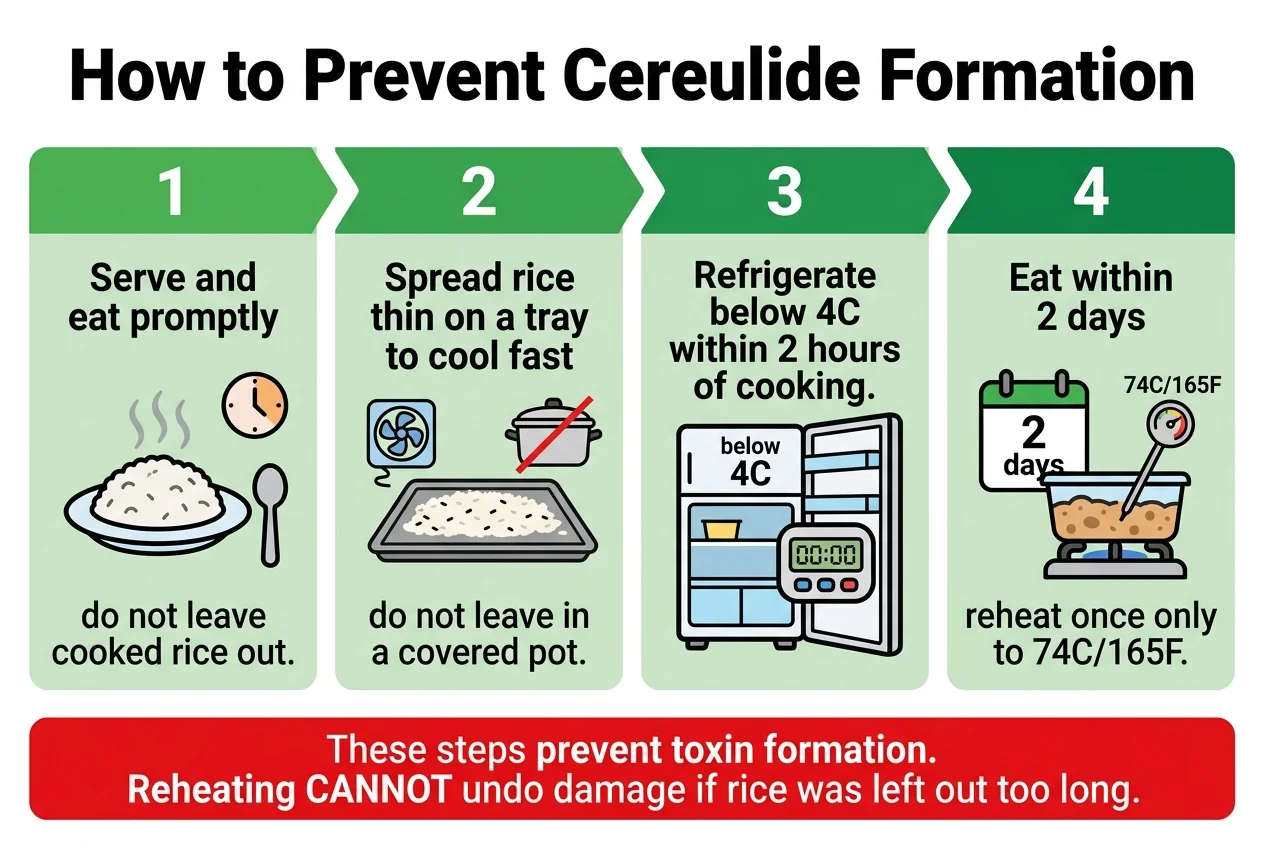
Because cereulide cannot be destroyed by cooking, the only effective strategy is to prevent it from forming in the first place. That means controlling the window between cooking and refrigeration.
The 2-hour rule: Cool cooked rice (and other at-risk foods) to below 4°C within 2 hours of cooking. The FDA Food Code recommends this as the outer limit; many food safety specialists suggest aiming for 1 hour to be conservative.
How to cool rice quickly:
- Spread it thinly on a large baking tray or across two containers rather than leaving it in a deep pot
- Do not leave rice sitting on a warm hob or inside a warm covered pot
- For large batches, use an ice bath under the container
Storage and shelf life:
- Store in a shallow, airtight container in the refrigerator
- Consume refrigerated cooked rice within 2 days, not 3 or 4 days
- Do not reheat cooked rice more than once
Reheating — the limits: Reheating to 165°F/74°C all the way through will kill any bacteria present, reducing the bacterial load. But remember: if the rice sat out long enough for cereulide to form, reheating will not make it safe. When in doubt, discard it.
A Note on Rice Cookers and "Keep Warm" Settings
Many rice cookers have a "keep warm" function that holds rice at approximately 60–65°C. At these temperatures, B. cereus bacteria cannot grow actively, which provides reasonable short-term protection for a few hours. However:
- "Keep warm" is not a substitute for proper refrigeration for longer storage
- If the rice cooker drops below 60°C at any point, the safe temperature window closes
- Rice left in "keep warm" mode for more than 4–6 hours should be treated with caution
The safest practice remains: cook, eat promptly, and refrigerate any remainder within an hour.
What This Means for Everyday Cooking
"Fried rice syndrome" sounds like a novelty food safety scare. In practice it points to a genuinely underappreciated hazard in the home kitchen. It strikes most during casual, low-attention cooking moments: the takeaway left on the counter, the pot of rice made hours before dinner, the office lunch left at room temperature.
The Cleveland Clinic's food safety guidance summarises it simply: cooked rice should be refrigerated within two hours and consumed within two days. These two rules eliminate virtually all real-world cereulide risk.
The complicating factor is that cereulide poisoning looks like ordinary food poisoning: nausea, vomiting, discomfort. Most people recover without ever knowing the cause. It's only in severe cases, particularly in children or people with liver conditions, that the full danger becomes apparent.
The Bottom Line
Cereulide is not a theoretical hazard. It's a real, heat-stable toxin that forms silently in cooked rice and other starchy foods when they sit too long at room temperature. It cannot be destroyed by cooking. Its only reliable countermeasure is time and temperature control: get cooked food into the refrigerator before the toxin has a chance to form.
The 2026 EFSA assessment of cereulide in infant formula is a signal that food authorities are taking this compound more seriously, and broader regulatory attention is likely to follow.
For most healthy adults, a case of cereulide poisoning means hours of misery. For infants, young children, and those with compromised liver function, it can mean something far worse.
IngrediCheck can't detect cereulide directly, since it forms after food is prepared rather than in the ingredients themselves. But IngrediCheck can help you understand the safety profile of packaged rice products, flag products under active recalls, and identify foods flagged for Bacillus cereus contamination, keeping you better informed about what's on your plate before you even start cooking.
If you want a faster reference for this specific hazard, keep the cereulide ingredient profile, the Food Contaminants hub, and the broader Ingredient Safety hub open alongside this guide.
On this page
Frequently Asked Questions
Does reheating rice destroy cereulide?
No. Reheating can kill live bacteria, but cereulide itself is heat-stable once it has already formed in the food.
Is Bacillus cereus toxin heat-stable?
The emetic Bacillus cereus toxin cereulide is heat-stable, so cooking, boiling, or microwaving may not make unsafe leftovers safe once toxin has formed.
How long can cooked rice sit out safely?
Cooked rice should be cooled quickly and refrigerated promptly. Long room-temperature holding gives Bacillus cereus spores time to grow and produce toxin.
What foods besides rice can be a cereulide risk?
Rice is the classic example, but pasta, noodles, grains, and other starchy prepared foods can also matter when storage temperature is unsafe.
Sources
Source lists are maintained with our editorial policy.
- Risk of Bacillus cereus in Relation to Rice and Derivatives – PMC
- Cereulide and Emetic Bacillus cereus – PMC NIH
- Fulminant Bacillus cereus food poisoning with fatal multi-organ failure – PMC
- EFSA Rapid Risk Assessment on Cereulide in Infant Formula – EFSA Journal 2026
- Preventing Foodborne Illness: Bacillus cereus – USDA NIFA
Next Label Check
Follow the scanner, hub, and ingredient paths connected to this guide
Topic hubs
Topic hub
Ingredient Safety
Explore IngrediCheck's ingredient safety hub for additives, contaminants, preservatives, and evidence-based label guidance.
Topic hub
Food Contaminants
Understand food contaminants including mercury in seafood, PFAS exposure, cereulide in reheated rice, and safety guidance.
Topic hub
Food Dyes
Browse food dye guidance for Red 40, Yellow 5, Yellow 6, Blue 1, Blue 2, Green 3, Red 3, and titanium dioxide labels.
Related articles
Ingredient Deep DivesArticle
Mercury Fish List: High-Mercury Fish to Avoid
Use this mercury fish list to avoid high-mercury fish like shark, swordfish, king mackerel, bigeye tuna, tilefish, and orange roughy.
Ingredient Deep DivesArticle
Arsenic in Rice and Baby Food: What Parents Should Know
Learn why rice can contain inorganic arsenic, what FDA's infant-cereal action level means, what labels cannot reveal, and how grain variety can reduce repeated exposure.
Ingredient Deep DivesArticle
Guar Gum: From Ice Cream to Baby Formula, What to Know
Guar gum is one of the most common thickeners in processed food. A 2024 EFSA re-evaluation and a 2026 EU regulation have now removed it from infant formula — here's what consumers need to know.
Get the app for clearer label decisions.
Scan labels, see what fits your food notes, and read the why in plain English.